
Cree Gunning from WeirdCo Inc, the company behind the Cyberpunk TCG offered to send me an Alpha Kit of the game, and share with the world what I thought about it.
In this article, we'll discuss my first experience with the Cyberpunk TCG through the prism of playing with a couple of friends while using quite basic decks. I'm sure this wasn't everything this newcomer in the card game space has to offer, but this was a great first step into the core mechanics of the Cyberpunk TCG.
Interested to give it a try or support their Kickstarter? Here's my honest review about it.
I will cover various aspects of the game in this piece, but feel free to read the full rules here.
The Alpha Kit
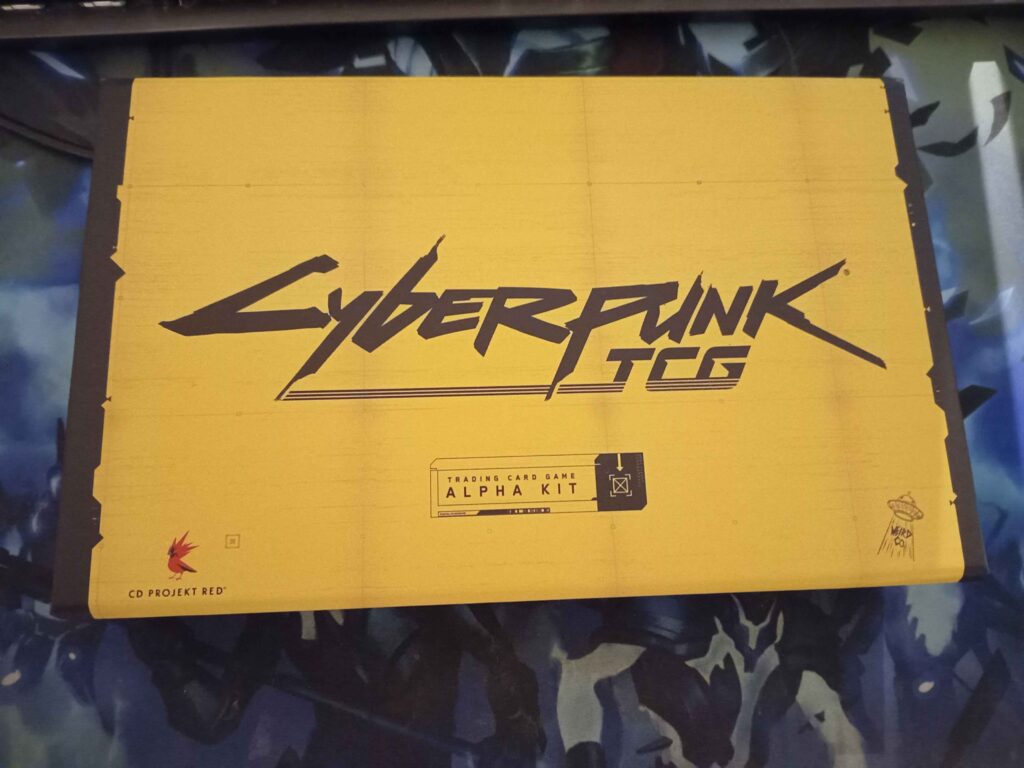
In that beautiful box, there was everything needed for two players to try the game.
Two paper playmats with the rules on the back
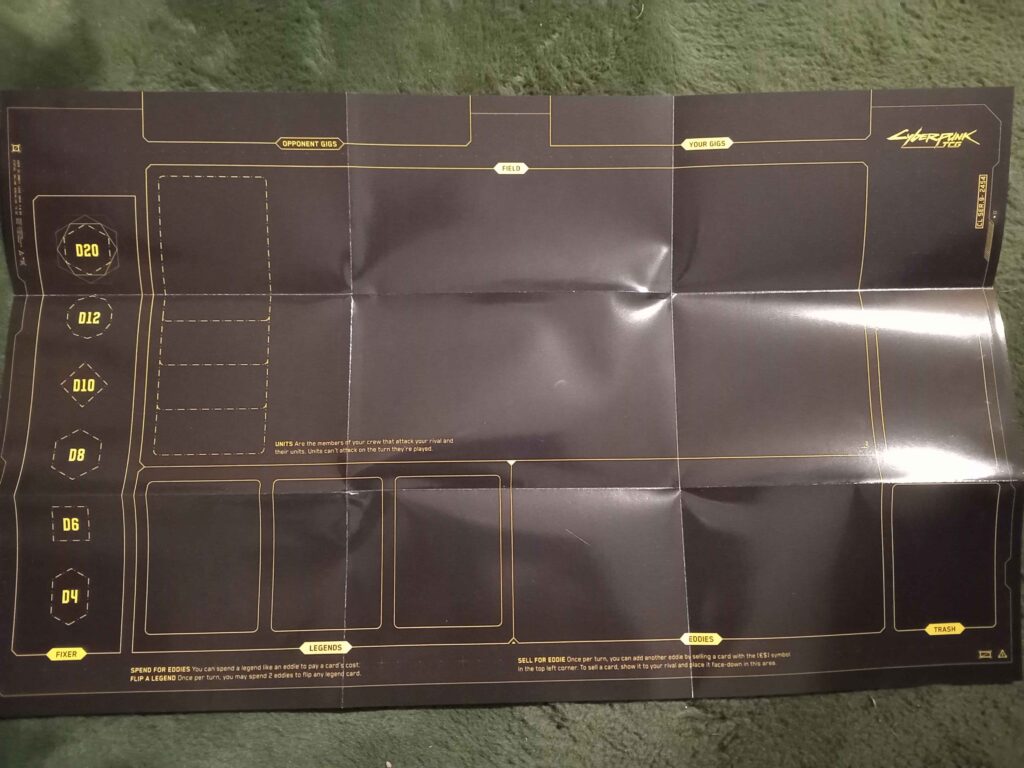
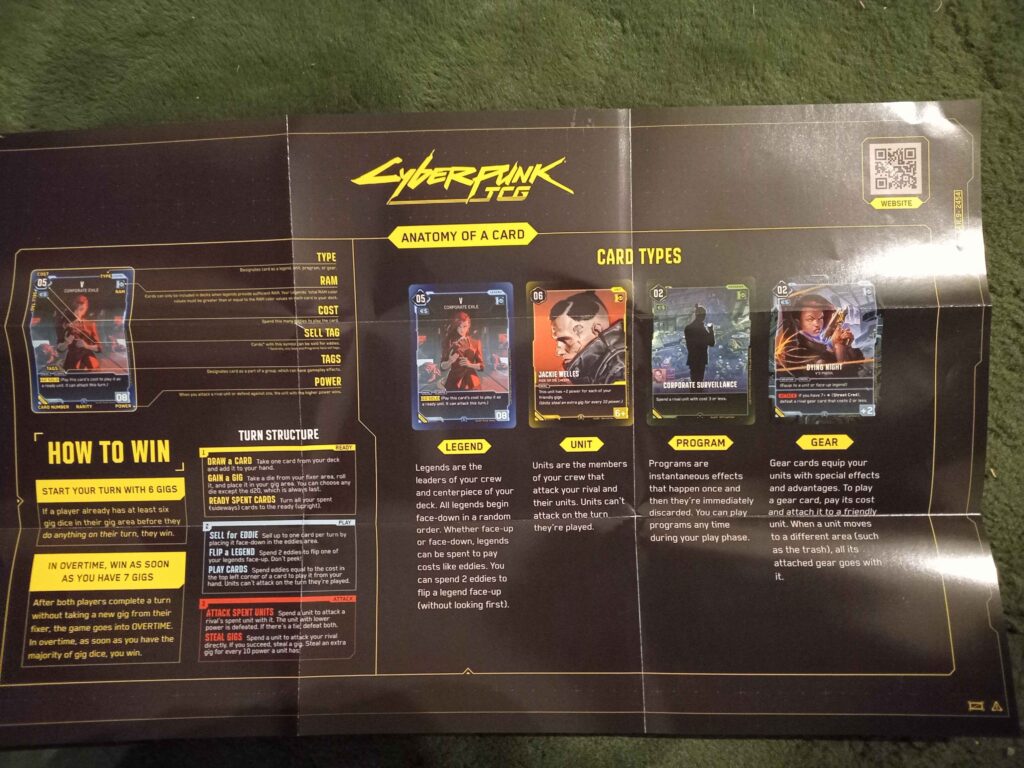
Nothing fancy here, as these simply showed the different areas we would use during a game. One good thing was that the rules and a description of each type of card was on the back.
With that, you have a visual explanation with you at all times. Very convenient in order to explain the game to a card game neophyte.
We also had those information on cards to keep with us while playing.
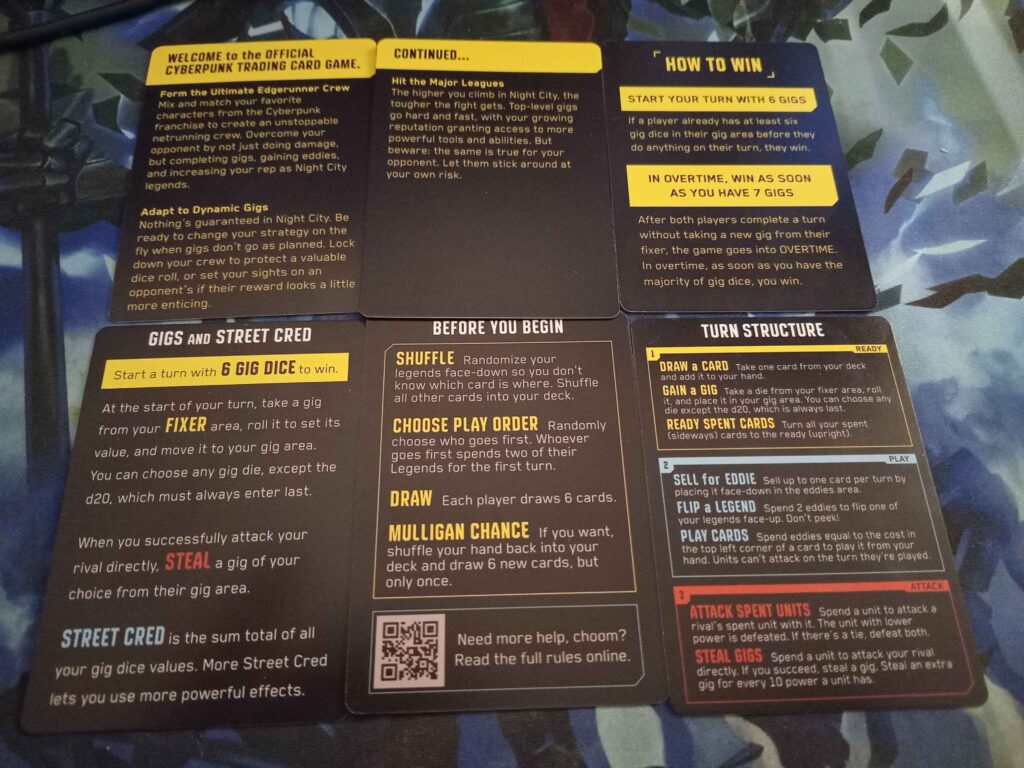
Two Pre-Built Decks
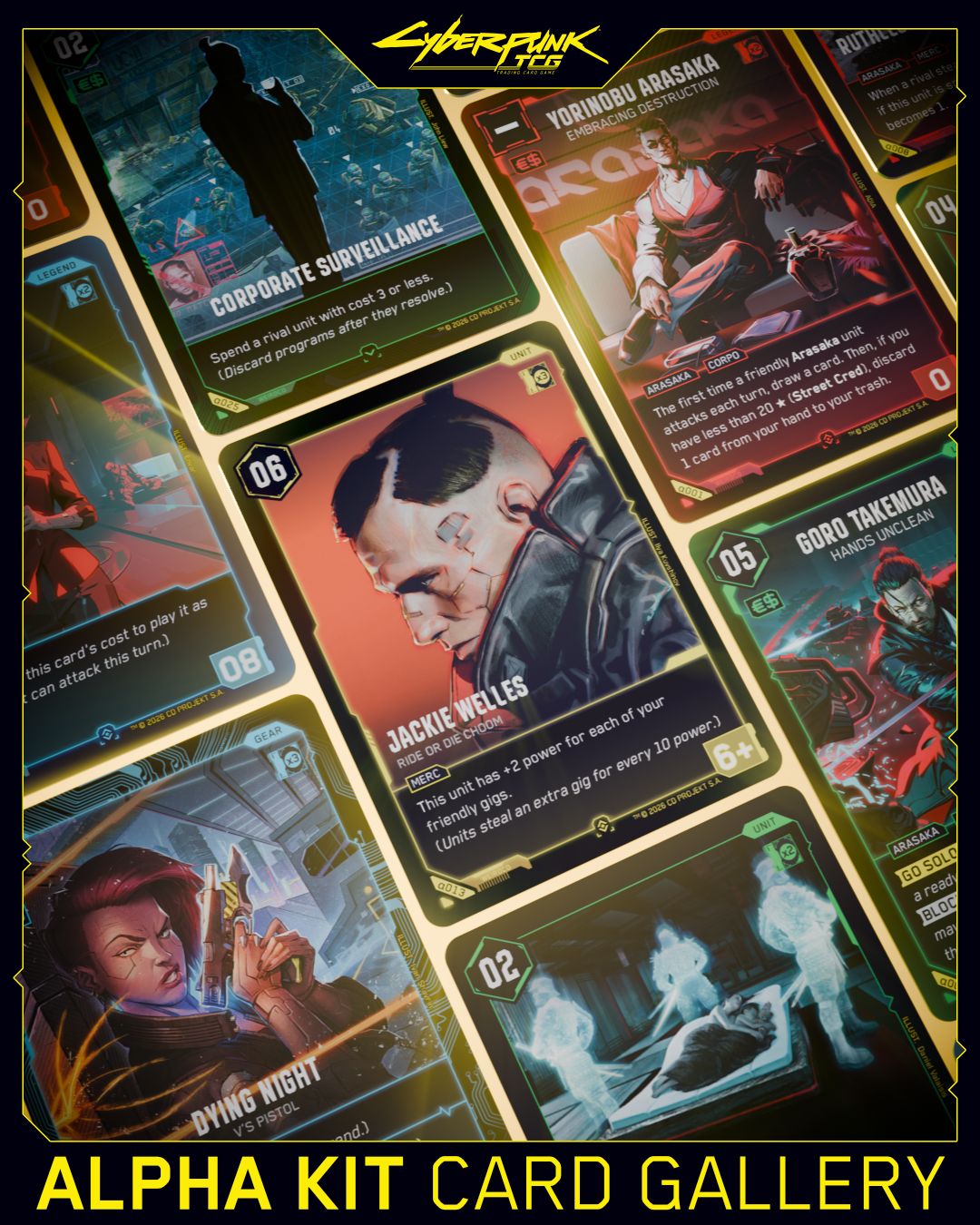
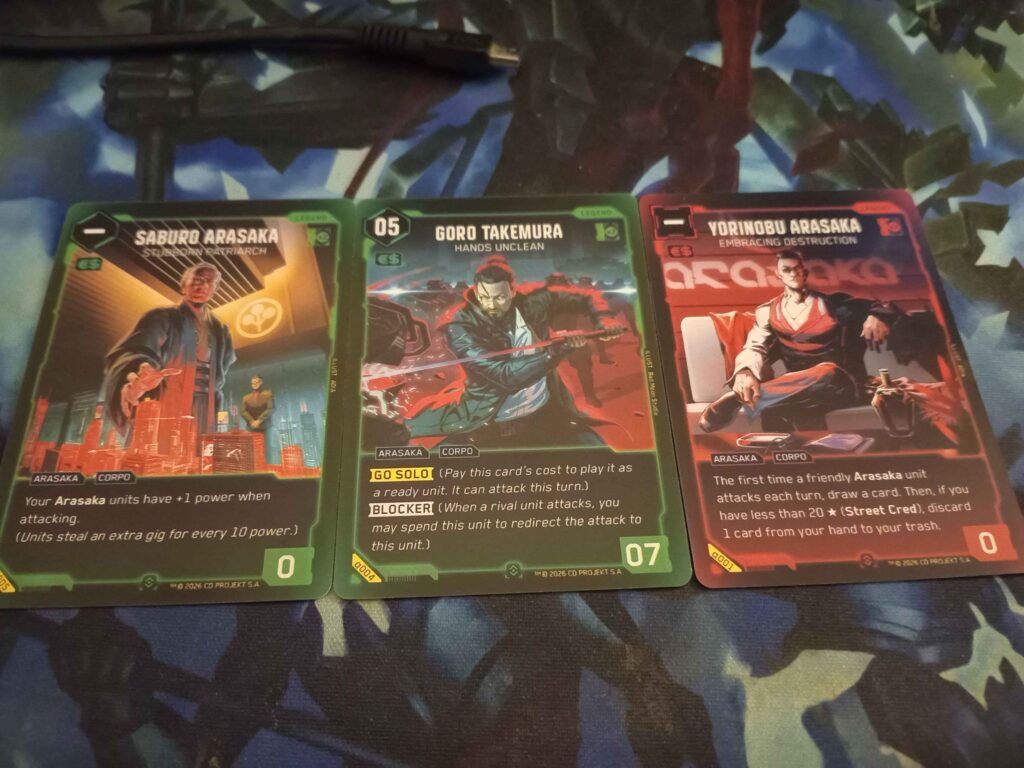
We had a Red - Green deck based around the Arasaka cards. It played like an aggressive build with various ways to buff units or support our attacks.
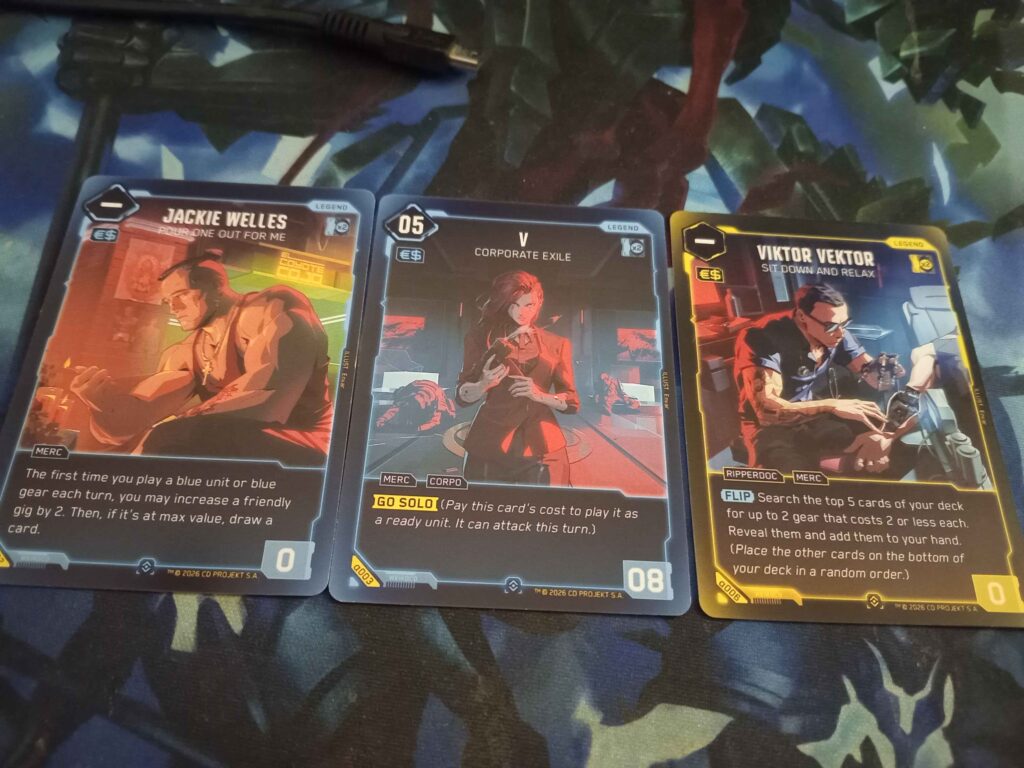
The other build was a Yellow - Blue control looking to extract more value out of its cards. There wasn't a main synergy except for drawing cards and winning a good old value based war.
Dice
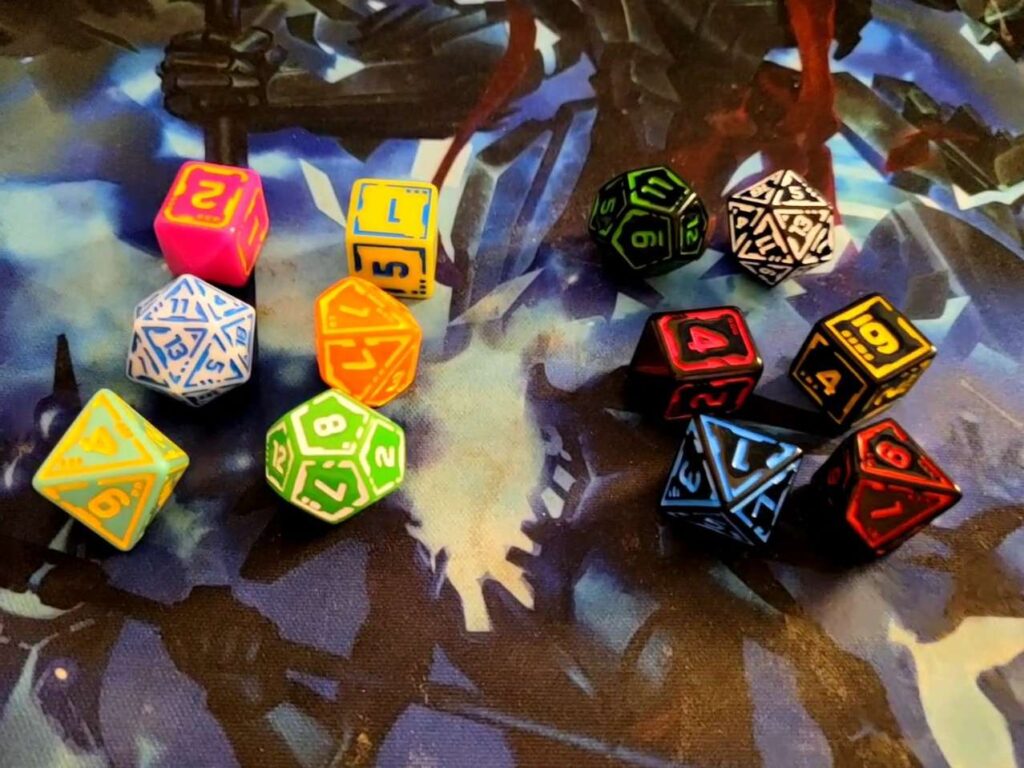
By far the most exciting part. Not only because I love the design of these dices, but also because they are the core of Cyberpunk TCG's gameplay.
How to Play and Win
We use our energy to play cards, which are either units, gears (equipment) or programs (spells). Then, we use our units to attack into our opponent's tapped units to build board advantage, or our opponent directly to steal one of their dice, essentially representing victory points.
Those victory points add up over time, as a new dice enters play at the start of each player's turn. To win a match, you need to start a turn with 6 dices in your control.
Once both players are out of dices to roll at the start of their turn, the overtime will start. In overtime, the first player to get 7 dice wins the match.
The mechanic of stealing each other's dices was by far the highlight of my testing session. Let's dive deeper into the game's core mechanics.
Core Gameplay Mechanics
Evolving Scoreboard
At the start of the game, each player will gain a dice per turn through picking one from the Fixer zone. However, the key to winning the game is to attack our opponent to steal their dices.
In doing so, we not only gain one victory point, but we also remove one from our opponent, meaning the scoreboard is constantly moving, until one manages to protect at least six cubes from a turn to another.
This lead to two distinct play-style to emerge in our testing session:
- The Red - Green aggressive deck would build advantage on the board early on, and then look to attack multiple times to steal many dices in a turn around turn five or six. This way, we could get to 8 or 9 dices, forcing our opponent to have at least three attackers to stop us from winning.
- The Blue - Yellow deck was slower to develop, and would typically use blockers to protect its cubes. Through constantly dealing with its opponent board while drawing cards, the deck just built a secure position when reaching 6 cubes.
Street Cred
The reason victory points are dices and not just points is because the value on each die is also important.
When we roll a dice at the start of our turn, the value we get will build our street cred. That score will trigger the abilities of our card during the match.
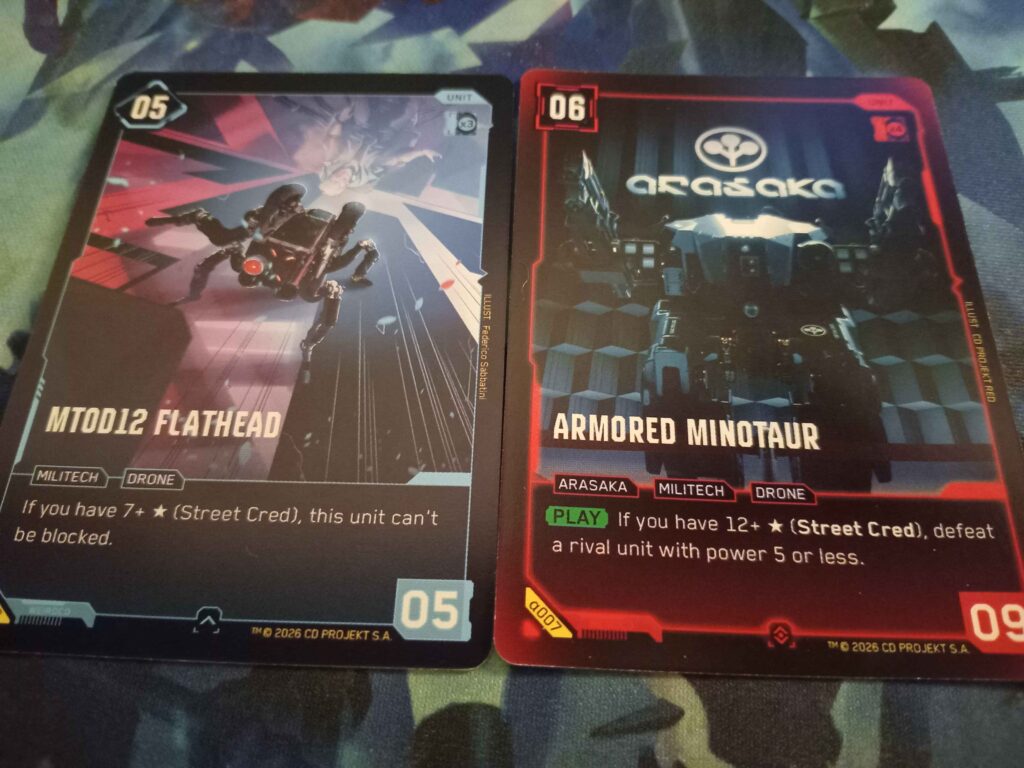
On top of trading victory points, stealing a cube from our opponent will also change both player's street cred.
In our testing, we always stole the highest value, as we had no reason to look for a small street cred, or have our opponent stay on a high one. In the future, it could open the way for some "If you opponent has more street cred than you do" or such shenanigans.
Legends
In most trading card games, our legend, hero, leader, or whatever you want to call it, has one job. It represents an ability, can sometimes attack and would like to not get hit in the face too much.
In Cyberpunk TCG, a legend doesn't represent us, meaning when the opponent attacks us, they aren't targeting our legend. Rather, they are faction leaders, sort of glorified units with their own area of play. We have three legends in our deck, and they start as blank energy, in their dedicated area on the play mat.
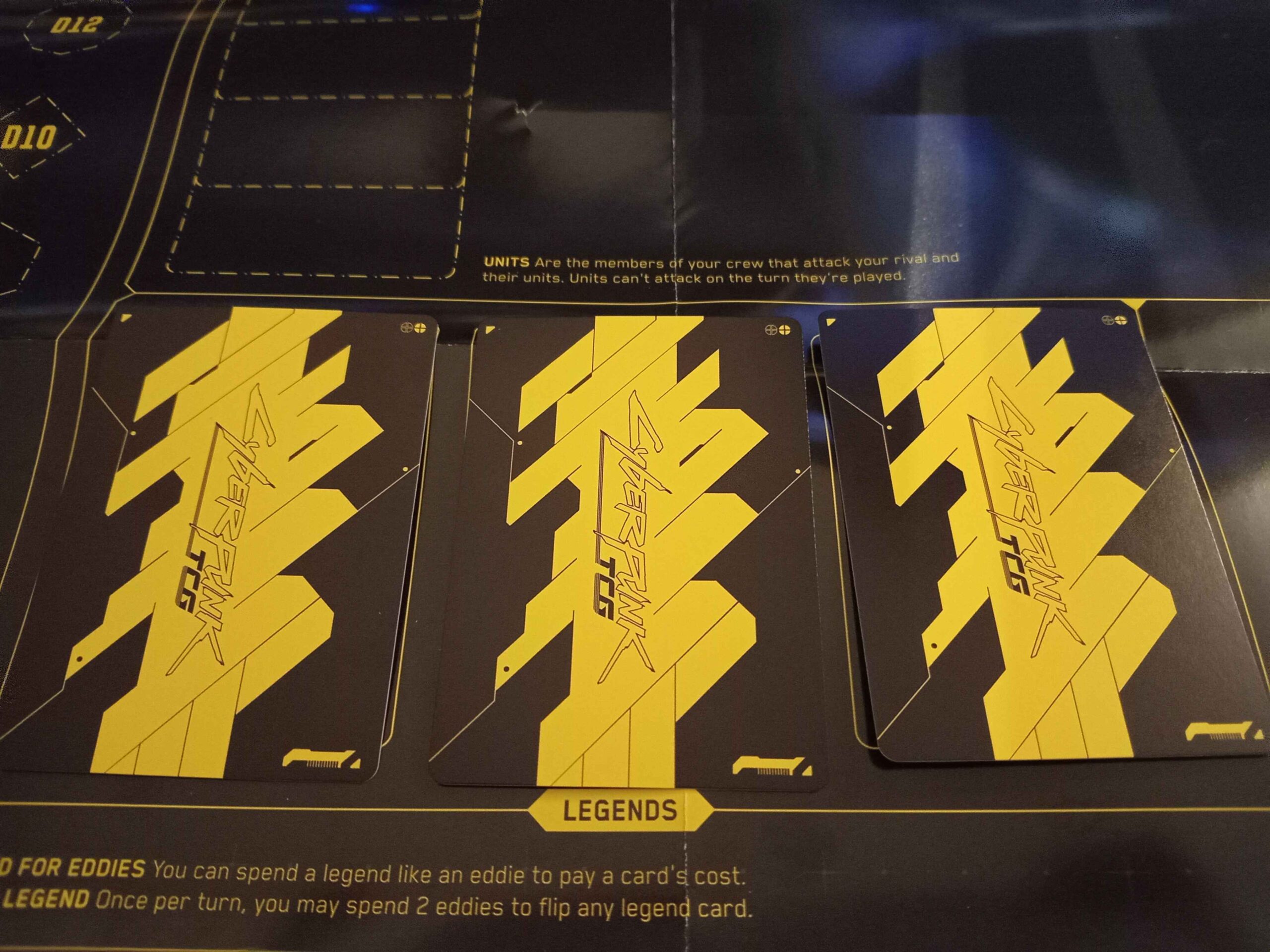
First, this means we start a match with three energy, possibly four if we add another one to our energy zone. To be fair, I didn't like that part much, as a large unit would come down early, and could run away with the game if left unchecked for multiple turns.
This probably had a lot to do with our deck lacking strong removal or ways to interact. Still, it was quite frustrating when a 7 power unit was played on turn one and stole 3 dices on her own over the course of the match.
However, we can also pay two energy to flip one of our legends face-up at any point, which would now make its ability be a factor.
There is a random element to this, as certain legends clearly are better to reveal earlier than others, and we don't know which is where. Yet, this mechanic also means we always have a way to spend our energy, even if our hand isn't great.
I disliked the random part of this mechanic, especially when certain legends are key to our strategy while other are just support, or require a specific setup to function properly. However, it was enjoyable to have that second decision available every turn, especially when our hand was starting to dry out.
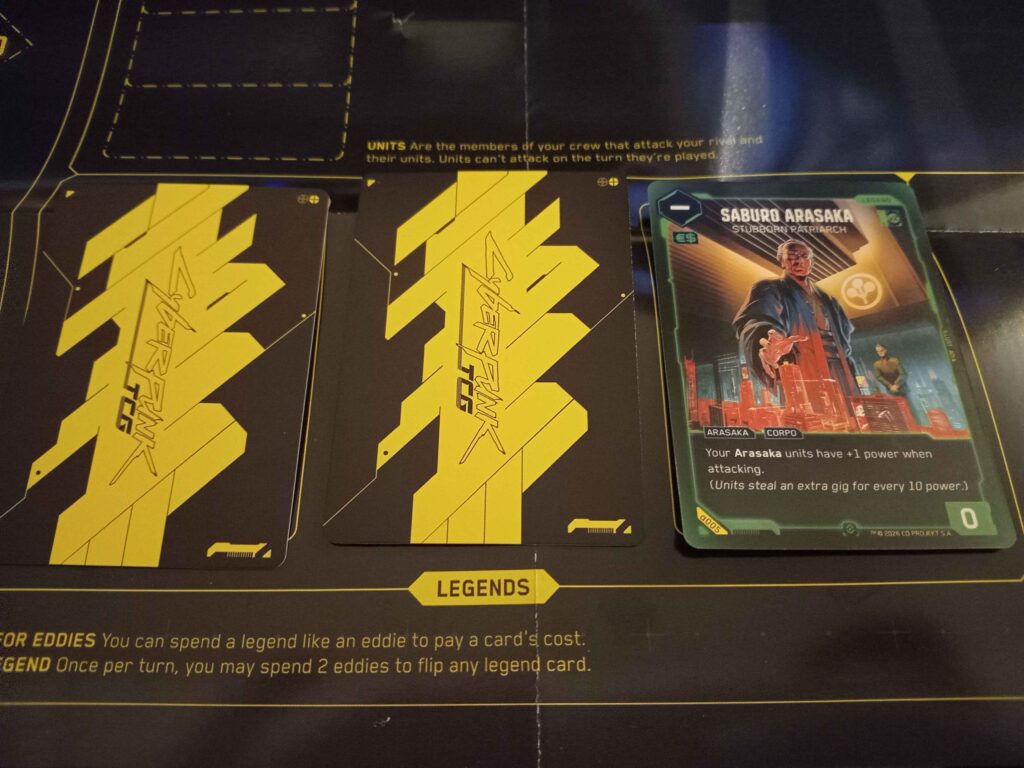
Last, legends will also have an impact on our deck building process.
Promising Deckbuilding Rules
Our deck must contain from 40 to 50 cards, and no more than three copies of the same card. However, there is a small difference compared to other color based games. If we look at Riftbound for example, you can play any card matching your legend's domains.
In Cyberpunk, you need to match the RAM (it's a counter) required to play a card on top of its color.

Through playing Goro Takemura as one of my legends, I open my deck to any green card with RAM of two or lower. If I want to include cards requiring more, I can pick a second green legend as part of my trio, and increase my RAM for the green color.
Just like the street cred, I feel like this is a nice deck building twist. In the alpha kit, every legend granted 2 RAM, which felt basic. However, I would love to see some legends grant more or less depending on their ability. In that context, the RAM would serve as a balance mechanism.
Plus, this means we should be able to play three colors, one per legend, if we accept to limit ourself to a low amount of RAM for each.
Three Big Limitations
So far, we have covered the mechanics I am excited about in Cyberpunk TCG. Unfortunately, there are two designs I definitely didn't enjoy when playing the game.
The Sell Tag Energy System
The first is the fact not all cards can be used as energy. Basically, this game uses a similar system to Lorcana, requiring us to place cards from our hand in our energy area if we want to grow our bank. If a card has a Sell Tag, we can use it as an energy, otherwise we can't.
This can be considered a way to print stronger cards with a flexibility drawback. Yet, I just can't go back to that system after playing Dragon Ball Fusion World, a game which allows me to place whichever card in my energy area.
In our prebuilt decks, spells and gears were cards we could use as energy, while units couldn't. As I said, one of the two decks was a Red - Green build centred around Arasaka units, meaning around two thirds of my deck could not be used as energy. As a result, I had a couple of games being stuck at four energy, for lack of cards to place in that zone.
Not only I feel like this is a limiting design without much reward to balance it. It also limits our ability to interact with our opponent during a match, since our support cards are the only ones we can use as energy.
Overall, limiting a player in its decisions is only good when it opens other areas for creativity. In that precise scenario, it felt like a limitation more than anything.
A Rigid Turn Structure
There are three distinct phases in a turn : Ready - Play - Attack.
As soon as I read the rules, I knew this would be infuriating, and it was as soon as I had to play a turn with an attack triggering a draw ability. After the first game, we collectivety decided to merge the Play and Attack phases, so we could attack and play cards in any order we wanted.
Let's rewind a bit so you can understand.
The ready phase is one we have in every card game. In Cyberpunk TCG, it consist of drawing a card, rolling a dice and turning our cards back to the ready position.
Then, there are two different things we can do : Play cards from our hand or use the ones already in play. In most card games, you can mix your turn however you like. Cyberpunk TCG decided it was better to split these two phases, and make player play cards first, and then be able to attack.
First, this is absolutely terrible in terms of interacting with our opponent and adapting to the situation. Indeed, our opponent knows once we start attacking, nothing else will happen since we are not allowed to play spells anymore, nor develop more units. At best, we can pay two energy to flip one our legends.
Then, there are some abilities which draw a card. This means I could draw a card and consider it in my turn, except attacking ends my window to play more cards. This goes against all my instincts as a card game players, and could be enough for me not to play the game again due to how frustrating it is to know you have resources available, but not be allowed to use them.
Very Little Interaction Overall
Obviously, playing with beginners' decks didn't help. Still, most games lacked a ton in terms of interacting with my opponent.
Here are things I would like to see changed:
- At the moment, spells can only be played during our turn, solely in the play phase. Not only it makes combats pretty dull as there is no tension going into a fight, it also greatly limits the way we can use those cards.
I guess it explains why those cards can be used as energy while units can't : because the game is mostly played with units.
- On top of cards not being playable during combat, the only way to redirect an attack is through the blocker keyword. Once again, this completely removes the tension of declaring an attack when there aren't blockers on the board. Not that there is much more with a blocker available, since it is only a matter of sequencing attacks properly, as the opponent is not allowed to play cards during our turn.
After a couple of games, it appeared clear that the player able to take a dice first was in a commanding position going forward. Indeed, they could simply stack the board with units without ever attacking so the opponent had little way to interact with those.
If our opponent attacks our dices, we simply take out their units through picking our trades. If they don't, we will eventually launch multiple attacks, get up to 10 dices, and place a wall of cheap blocking units to ensure victory.
- The way a turn is designed is way too limiting. Every other TCG lets us mix playing cards from our hand or using those in play as we wish, and it is probably because it is more enjoyable.
- In the Alpha kit, the Street Cred and the RAM concepts were barely reflected in the gameplay. These are part of the game main assets, and need to be an emphasis for Cyberpunk TCG to feel unique and enjoyable.
- Allow any card to be used as energy, unless this restriction leads to more design opportunities in the future. Otherwise, this will not only create a bad experience when a player is stuck with little energy, it will also standardize deckbuilding as decks won't be able to build without a minimum amount of cards with a Sell Tag.
Closing Words
To be honest, I had a good time trying to understand the rules and how the back and forth of dices worked. However, past that early discovery, Cyberpunk TCG felt closer to Hearthstone in its infant days than the current card games available. One Piece, Dragon Ball Fusion World, Riftbound, Marvel Snap and most other popular games feel more flexible and dynamic. If I had to compare this one to an existing one, I would say Gundam TCG probably is the closest, and there is a reason the hype around that game died out fairly quickly.
Sure, I only played with an alpha kit with several cards in my deck being just a cost and a power value. Still, after a few games, it felt like I lacked the opportunity to make interesting decisions. Typically after a game with a friend, you discuss it a bit, talk about certain plays, exchange your ideas looking back on the situation. There wasn't much of that unfortunately. A few games ended in "Well, that [4/7] on turn one sure kicked my ass", or one of us conceding because we knew exactly what was about to happen the following turn.
There are some cool designs Cyberpunk TCG can build upon. The evolving scoreboard is a great idea, and the Street Cred can serve as an extra layer of decisons. Plus, the random elements such as flipping our legends or rolling dice felt more fun than frustrating overall.
However, until the game is more flexible, and really makes me feel like I am playing with another person, I can't consider investing myself in Cyberpunk TCG.